
There is a certain kind of alchemy that happens in football, where the high-stakes drama on the pitch collides with the raw, unfiltered world off it. This is where legends are not just made by goals and trophies, but by moments of pure, unscripted humanity. In the grand, often theatrical rivalry between Barcelona and Real Madrid, a new character has taken center stage not with a silent, stoic glare, but with a mischievous smile and a blunt, viral accusation.
It started a few days before the latest El Clásico. In a live stream that felt more like a chat among friends than a formal press conference, Lamine Yamal was put on the spot. The question was a classic bait, designed to generate a headline. And the 16-year-old, with the unflinching honesty of youth, took it. "They steal, they complain, they rob," he said, a mischievous grin playing on his lips. The footballing world gasped, then leaned in. This wasn't a polished club statement; this was a kid from the neighborhood saying what everyone in his corner of the world was thinking.
To understand the weight of his words, one must first understand the journey that forged him. He is not a product of a sanitized football factory, but of Rocafonda, a working-class neighbourhood in Mataro. His story is one of a quiet boy who honed his skills on the hard-surface courts of Plaça de Joan XXIII. When he scores, he doesn't just celebrate; he signals "304"—the final digits of Rocafonda's postcode—a permanent, proud shout-out to the community that raised him. It is a gesture that speaks of loyalty, identity, and a past that keeps him grounded amidst the soaring fame.
His cheeky comment immediately drew fire. Pundits called it disrespectful; rivals called it naive. They demanded he focus on football. But for Culers, it was something else entirely: it was vindication. It was one of their own, their canterano, giving voice to a deep-seated, collective feeling of injustice. The truth, as they saw it, had been spoken aloud by the unlikeliest of prophets.
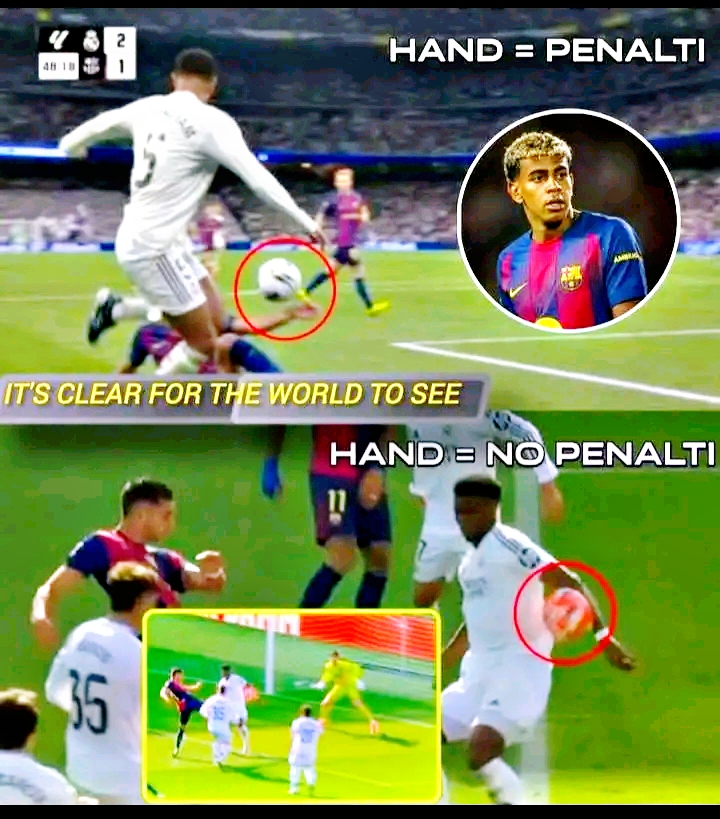
And then, the match happened. The script felt hauntingly familiar. As the game hung in the balance, the whistle blew. A penalty for Real Madrid. The reason? A minor, arguably accidental handball. In that moment, every Barcelona fan from Catalonia to every corner of the globe shared a single, exasperated thought: Here we go again. The collective memory of the fanbase flashed back to a previous Clásico, where a Madrid player had blocked a shot with his arm, and the outrage was met with silence. The narrative of favouritism, of a tilted pitch enforced from a windowed room, felt more real than ever.
This is the human side of football they don't show in the highlight reels. It’s the gut-wrenching anxiety of watching a referee point to the spot, and the feeling that the outcome is preordained. It’s the shared sigh, the clenched fists, the cry of "not again."
But then, a different kind of human drama unfolded. Wojciech Szczęsny, the veteran goalkeeper, stood tall. He read the intention, dove with conviction, and palmed the ball away. The roar that erupted from Barcelona supporters wasn't just about a saved goal; it was a roar of defiance. It was a cathartic release from years of perceived injustice. In that single save, Szczęsny didn't just save a point; he saved the narrative. He was the embodiment of every underdog who ever pushed back against a seemingly inevitable fate.
The final whistle blew, and the truth Lamine Yamal had spoken with a smile was now felt with the raw emotion of a reprieve. His words weren't a curse; they were a diagnosis. The boy from Rocafonda, who carries his postal code on his fingers, had simply called it as he saw it. He reminded everyone that football isn't just played by robots following a script written by algorithms and dubious refereeing decisions. It's played and felt by people—a teenager's brave taunt, a goalkeeper's heroic defiance, and the collective heartbeat of millions who believe, against all odds, in justice on the pitch.
In the end, the phrase "steal and complain" is more than just a headline. It is a modern football fable. It is the sound of the new challenging the old, of local pride clashing with global empire, and of a teenager, forged in adversity, who is not afraid to speak his truth, one mischievous word at a time. And for one night, at least, that truth was validated not by a whistle, but by a save.
Thanks for reading.
Comment and share, we'll like to have you back here







1 Comment(s)
Leave a Comment
The boy get lucky say them no chop him eye